6 Reasons Home Cooks Are Switching to PFAS-Free Titanium Pans
Most of us never think about the surface under our food, until we notice the scratches.
By the Maison Ferré editorial team · Sources & material documentation
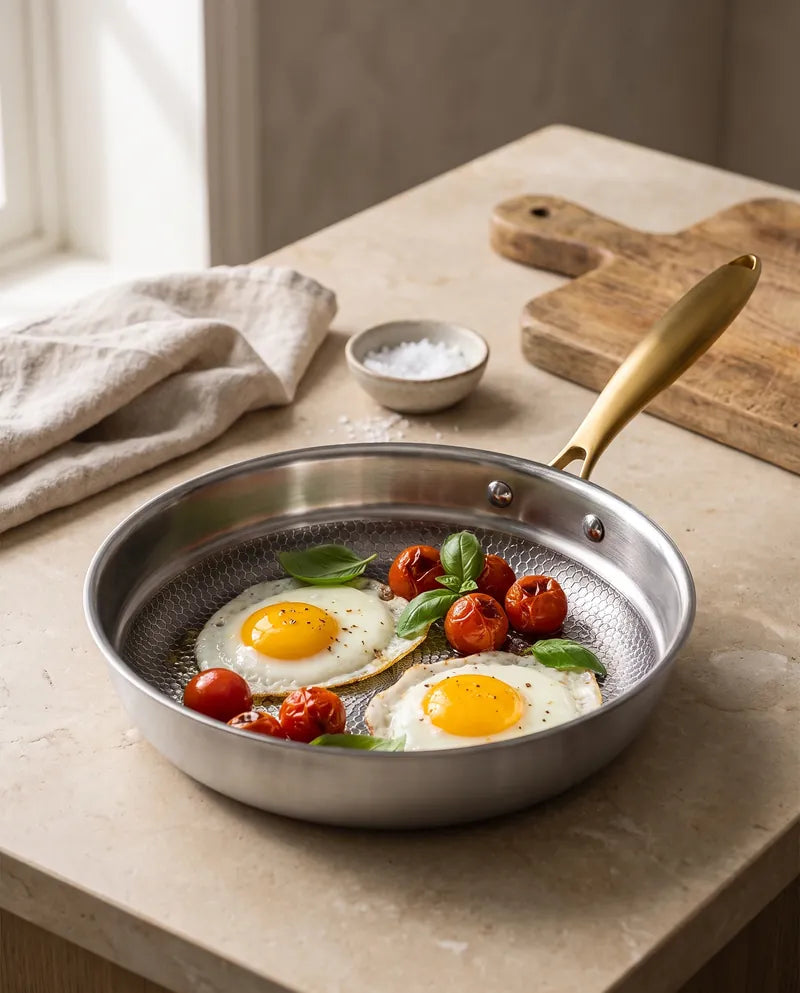
Before the 6 reasons
Take a Look at the Pan You Cook With Most.
Not the outside. The inside. Is it still perfectly smooth? Or are there scratches, a dull patch in the middle, marks from the spatula you were told never to use?
Most of us see those signs and keep cooking. Breakfast, dinner, food for our families. We assume that's simply what happens to a pan.
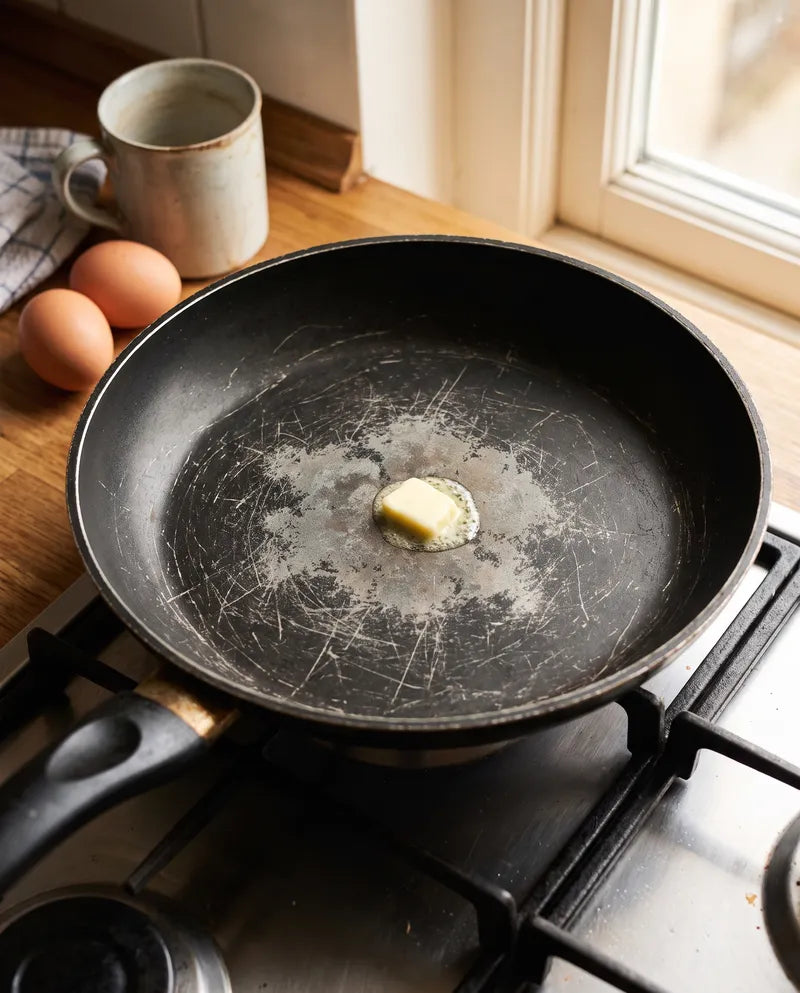
But on many pans, the “non-stick” part is a separate layer applied over the metal. Once you know that, those scratches look different. And a simple question follows:
If the surface is wearing away… where is it going?
So we stopped asking “which non-stick pan next?” and asked “why are we cooking on a coating at all?”
You probably check what's in your food. But when did you last check what it's cooked on?
Here Are the 6 Reasons It Makes a Difference.
01Reason 1 · Look at your current pan
That Scratched Surface Is the Part Touching Your Food
You didn't buy your current pan because you wanted to cook on a coating. You bought it because it was convenient. Food didn't stick, cleanup was easy, and at first the surface looked perfect.
Then came the first scratch. Then the dull spot. Then another scratch. Most people keep using it anyway, because nobody stops to ask what that smooth surface actually is.
 Conventional coated pan
- Pan bodyusually aluminium
- Applied non-stick coatingoften PTFE, which is a PFAS
- Your foodcooks on the coating, which wears with use
 Titanium Pan
- Titanium cooking surfaceGrade 1, tested 99.86% pure
- No PFAS-based coatingnothing applied on top
- Your foodcooks directly on titanium
The Titanium Pan has no applied layer. Your food cooks directly on titanium: no conventional PFAS-based non-stick coating between dinner and the pan itself.
One dinner isn't the point. Repetition is.
The Sunday eggs. The quick pasta after work. The dinner you make for your children without thinking about the pan underneath. Hundreds of meals a year, on the same surface.
Is PTFE Really a PFAS?
Yes. Under the OECD's 2021 definition, fluoropolymers such as PTFE belong to the PFAS family. Food-safety authorities consider an intact PTFE coating low-risk in normal use. The concerns are overheating, worn coatings and the PFAS used and released when these materials are made and disposed of.
What Happens When a Non-Stick Coating Breaks Down?
Germany's Federal Institute for Risk Assessment (BfR) notes that PTFE coatings can begin to decompose when a pan is overheated, from roughly 260 °C, which an empty pan on a high flame can reach within minutes. Scratched coatings also stick more, cook less evenly and end up being replaced.
02Reason 2 · Performance without the coating
You Shouldn't Have to Choose Between Peace of Mind and a Pan That Actually Works
“But without a normal non-stick coating, won't everything stick?”
Fair question. Giving up coated cookware shouldn't mean food welded to the pan. You still want eggs that slide out, fish that releases, pancakes that flip.
That's what Glissium™ is designed to solve: a honeycomb micro-texture worked into the titanium itself. Food rests on tiny peaks, so it lets go more easily.
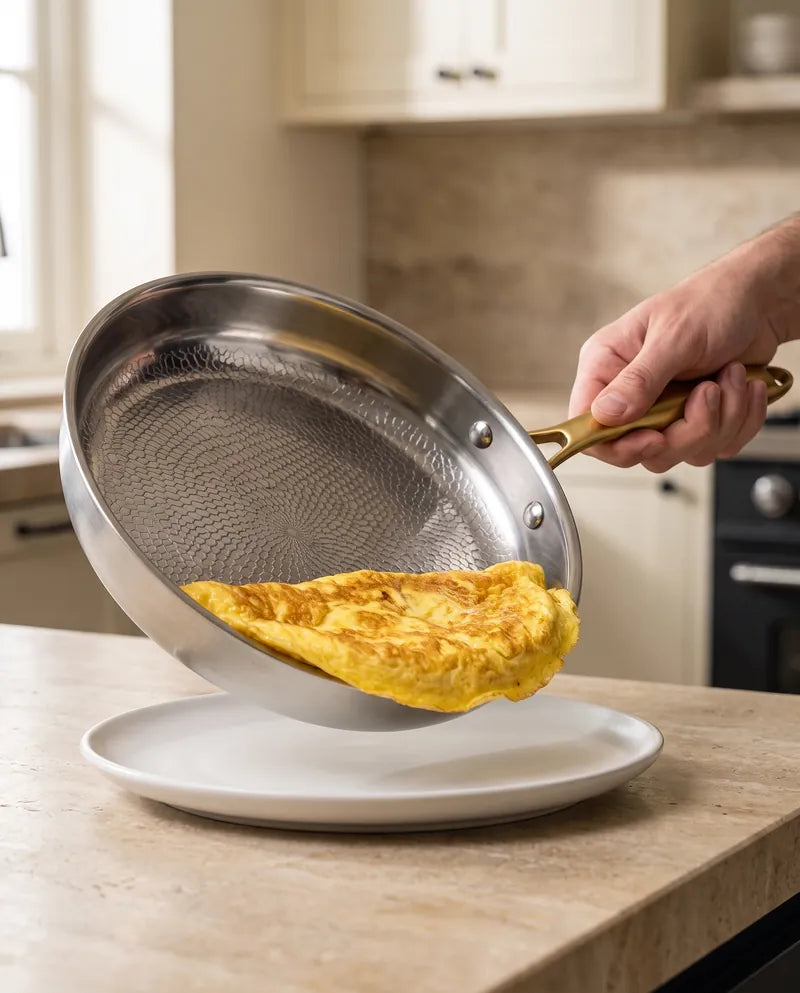
- Easier release designed to reduce sticking.
- Minimal oil a thin film is enough for most cooking.
- Nothing to peel Glissium™ is part of the titanium surface, not a coating applied over it.
PFAS-free shouldn't mean frustrating cooking.
How Do I Get the Best Release?
- Preheat 2–3 minutes on medium heat.
- Add a thin film of oil.
- Wait until the food releases on its own before turning it.
03Reason 3 · Built to actually cook
Titanium Where Your Food Touches. Performance Underneath.
“But does titanium actually cook well?” On its own, titanium isn't a great heat conductor, so we don't ask it to be. The pan is engineered as a system, and each layer has one job.
5 layers, top to bottom
- Titanium cooking surfaceWhat your food touches. Grade 1, no coating, Glissium™ texture
- Aluminium coreMoves heat quickly
- Aluminium coreSpreads it evenly to the edges
- Aluminium coreHolds a steady temperature
- Stainless-steel baseStructure, and makes it compatible with induction
Construction as documented on the product page. The aluminium layers are made from recycled aluminium.
At the hob
Serious cooking
Built Around the Demands of Serious Cooking
High heat, constant use, metal tools, service after service. A cooking surface with no coating to chip is built for exactly that.
- Consistency the same surface in year five as in week one.
- Metal utensils welcome, there's no coating to protect.
 -55%
-55%The PFAS-free Titanium Pan
Ready to Leave Coated Pans Behind?
106,95 €237,95 €
04Reason 4 · Less kit. Less fuss.
Why Are We Babying Our Cookware?
Don't use metal utensils. Don't heat it too high. Not that one in the oven. One pan for eggs, another for steak, another for induction.
At some point, cookware starts feeling like equipment you protect instead of equipment that helps you. One pan. Fewer rules. Less clutter.
One pan
Every cooktop
Easy after dinner
From breakfast eggs to a steak finished in the oven, without changing pans three times.
05Reason 5 · Buy better. Replace less.
How Many “Last Pans” Have You Already Bought?
Think about the pans you've thrown away. The one that started sticking. The one that scratched. The one that warped. The “premium non-stick” one you promised yourself would be different.
A few years later, you were shopping again. That's the strange thing about cheap cookware: you don't buy it once. You keep buying it.
- Buy
- Cook
- Surface wears
- Replace
- Repeatevery few years
- Buyonce
- Cook
- Keep cookingno coating to wear away
- Lifetime warranty
Illustration, not a guaranteed lifespan.
The value of titanium isn't only what it costs today. It's what you may no longer have to keep replacing.
06Reason 6 · Verify it yourself
Anyone Can Print “Titanium” on a Box.
Turn over enough cookware packaging and you'll see the same words: “healthy”, “non-toxic”, “titanium”, “PFAS-free”. Marketing words are easy. Documentation is harder.
So don't just trust ours. Check it.
Don't buy titanium because a brand writes “titanium” on the box. Look at what the cooking surface is actually made from.
Real Kitchens. Real Titanium Pan Moments.


Low risk to try
Take Your Time. It's Built to Last.
100-Day Return Window
Return it within 14 days for any reason, and unused pans up to day 100.
Lifetime Warranty
Covered for life against manufacturing and material defects under normal use.
Think About the Pan Sitting in Your Kitchen Right Now.
How old is it? Is the surface still perfect? Would you buy that exact same pan again today?
If the answer is no, maybe it's time to stop replacing the same problem.

PFAS-free · Titanium · Glissium™
Switch to the PFAS-Free Titanium Pan. Save Up To 55%
Titanium where your food touches. Glissium™ where performance matters. Lifetime warranty for the years ahead.
Price shown for 26 cm – Small Size. Also in 28 and 30 cm.
Quick answers & sources
Your Questions, Answered
Is it pure titanium all the way through?
No, and that's deliberate. The cooking surface is Grade 1 titanium (tested 99.86%). Underneath are three aluminium layers for even heat and a stainless-steel base for induction.
Metal utensils, induction, oven, dishwasher?
Yes to all four. Hand washing keeps it looking its best.
Is it as slippery as a brand-new Teflon pan?
Honestly? Not on day one with zero oil. A brand-new PTFE pan is very slippery, until the coating wears. Glissium™ needs a preheat and a little oil, and it should behave the same in year five as in week one.
What if I change my mind?
Return it within 14 days for any reason, and unused pans up to 100 days after delivery. Full return policy.
Sources & material documentation
- Material data (Grade 1 titanium, 99.86% purity, PFAS testing, layer construction): Titanium Pan product page and lab documentation (SGS).
- OECD (2021), Reconciling Terminology of the Universe of Per- and Polyfluoroalkyl Substances.
- German Federal Institute for Risk Assessment (BfR): questions and answers on PTFE-coated cookware.
The information on this page is for general information only and is not medical advice. It does not replace advice from a healthcare professional and is not intended to diagnose, treat or prevent any disease.