What your cookware really changes
We choose our ingredients with care, we read the labels, we favour fresh food. Then we cook it all in a pan whose composition we know nothing about. Yet the cooking material is the only element in the kitchen that touches every piece of food, at every meal, for years.
A coating is not a material
This is the distinction that explains almost everything. A classic non-stick pan is not made of a non-stick material: it is an aluminium pan onto which a layer of a few micrometres has been applied. This layer is what makes cooking easy—and it is also what wears out.
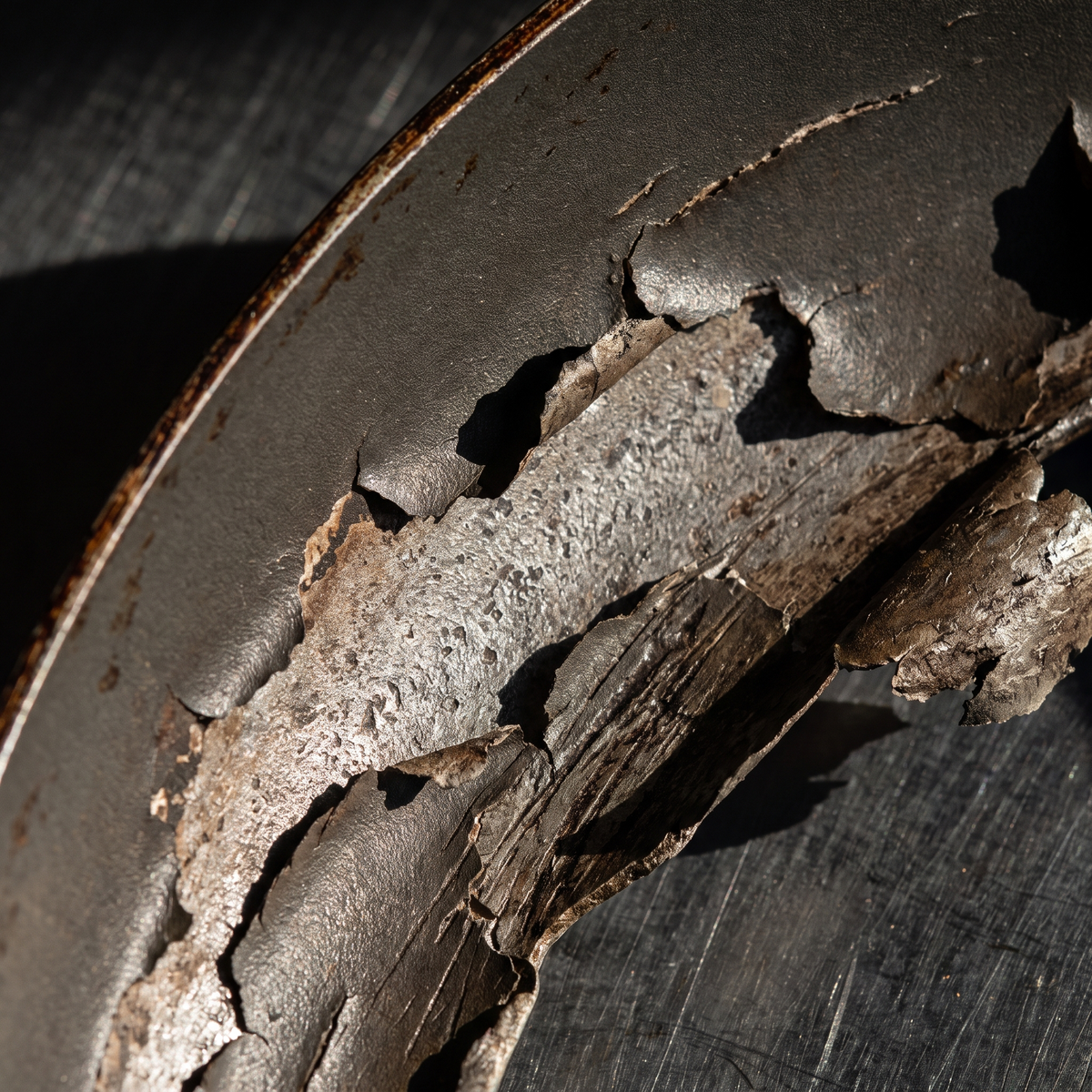
A coating has a lifespan. It is measured in years, sometimes months depending on use. A metal spatula, a dishwasher, repeated overheating, and the layer gets scratched, flakes off, and peels away. What appears underneath was never intended to come into contact with food.
A non-stick pan is not a durable utensil. It is a consumable you replace every two to three years.
The question of temperature
PTFE coatings are stable under normal cooking conditions. The problem arises beyond that: from about 260 °C, the polymer begins to degrade and release volatile compounds. Yet an empty pan left on high heat exceeds this temperature in two to three minutes — forgetting a pan while it preheats is enough.
Titanium, on the other hand, only melts at 1,668 °C. There is no household threshold at which the material changes its nature. This is not a marketing claim: it is simply the difference between a material and a coating.
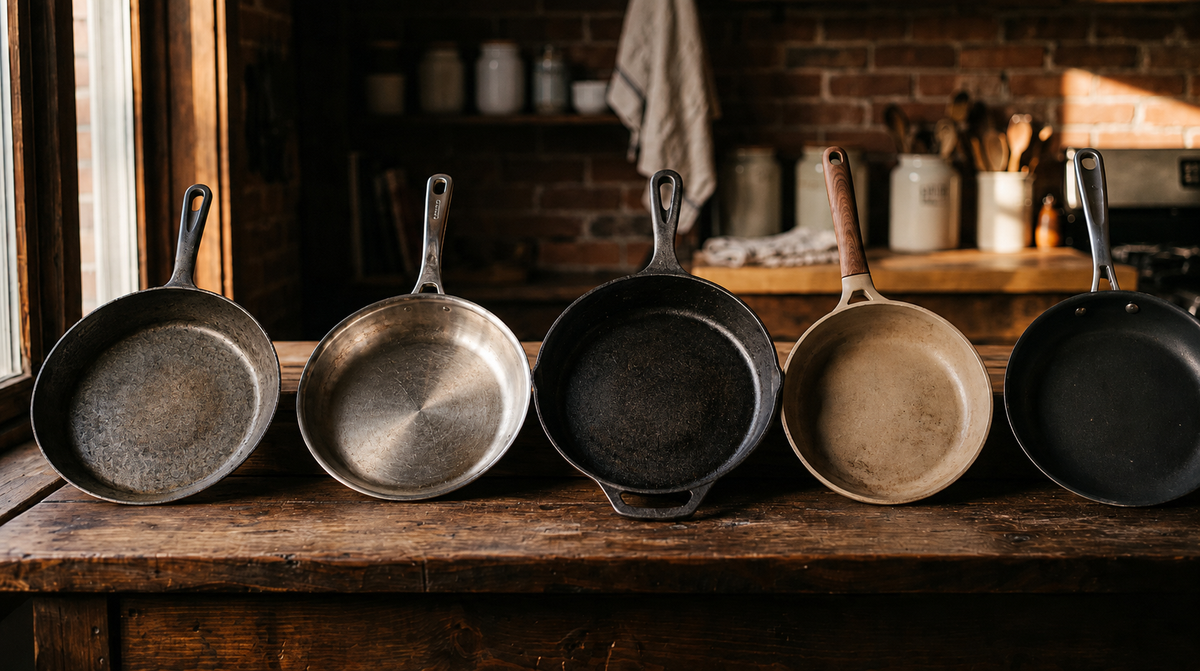
| Material | What it offers | Its limitation |
|---|---|---|
| Non-stick (PTFE) | Instant release, low price | Coating that wears out and scratches; degradation above 260°C |
| Stainless steel | Robust, uncoated, proper searing | Everything sticks unless you master preheating and fat |
| Ceramic | PFAS-free, clean look | Rapid loss of non-stick effect, often in less than a year |
| Cast iron | Thermal inertia, longevity | Weight, upkeep, seasoning to maintain |
| Titanium | Solid, stable, and unalterable material | Needs proper preheating — that's all |
PFAS: why the issue won't go away
PFAS include several thousand fluorinated compounds used since the 1950s for their non-stick and waterproofing properties. Their common characteristic is their extreme stability: they break down very slowly in the environment, which has earned them the nickname ‘forever chemicals’.
This persistence explains the growing regulatory attention in Europe, where several member states have initiated a restriction process for the entire family rather than molecule by molecule. The scientific and political debate is ongoing; it is not settled. But the underlying logic is simple: with a utensil that contains no compounds from this family, the question never arises.
What titanium changes day to day
Titanium has been used for decades where failure is not an option: medical implants, aerospace, surgical instruments. This is not a kitchen material repurposed for the occasion—it is a material chosen for its stability and resistance to corrosion, for which the kitchen is just one application among many.
In practical terms, in a home kitchen, this translates into three things. The material does not scratch like a coating: metal utensils are no longer forbidden. It does not degrade with heat: accidental overheating has no consequences. And it does not lose its properties over time: the pan in its fifth year performs just like it did on the first day.
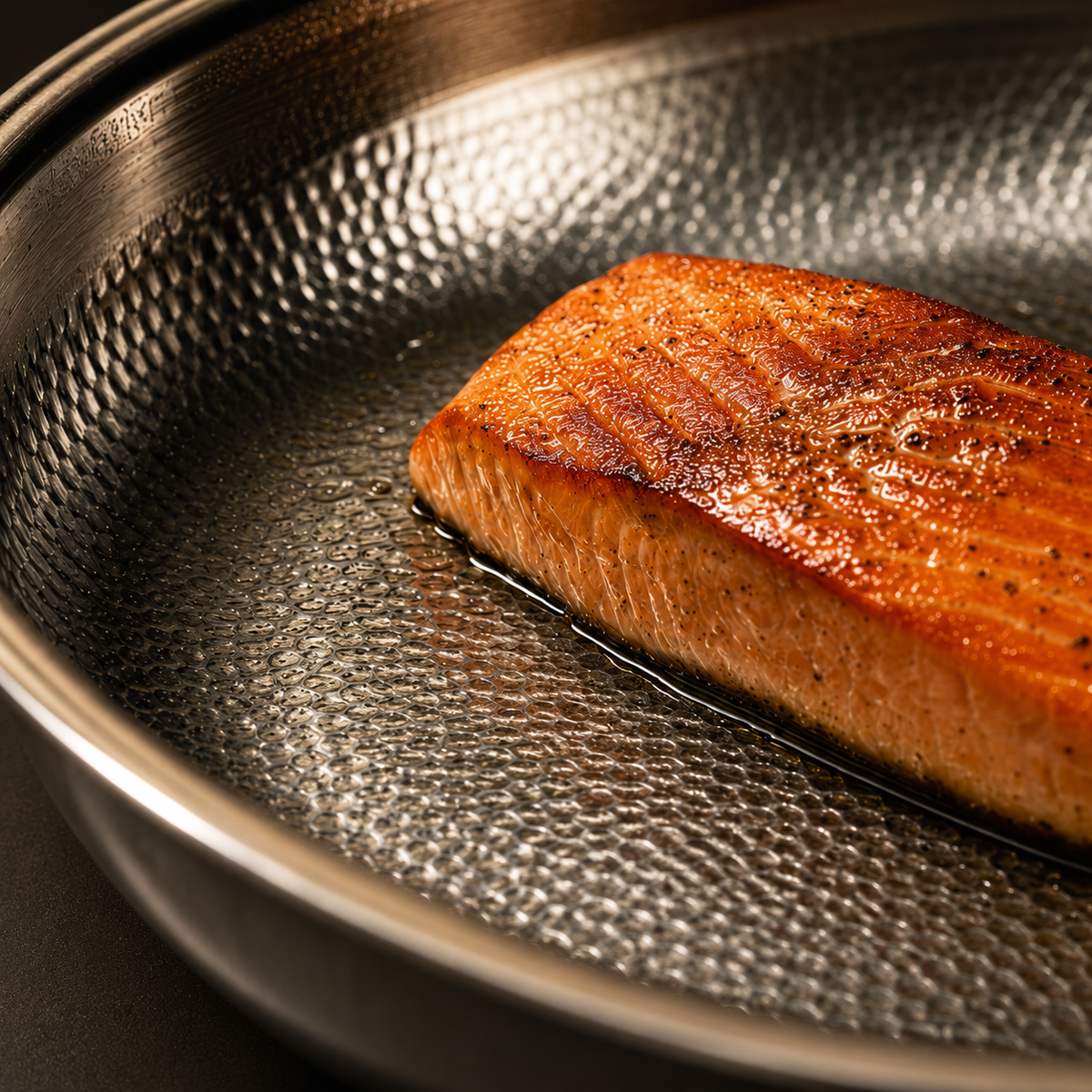
The Maison Ferré® Glissium™ Technology surface is structured, not applied. There is no coating to preserve — there is a surface geometry that is part of the metal itself.
How to evaluate a frying pan before buying it
- Look for the word “coating”.If it appears, there is a layer to wear down, regardless of its composition.
- Check the warranty.A two-year limited warranty on the non-stick coating indicates exactly the expected lifespan.
- Check compatibility with metal utensils.A manufacturer that prohibits them tells you that the surface is fragile.
- Ask for the maximum temperature.A low figure is a degradation threshold disguised as usage advice.
Changing frying pans is no small matter, and it is not a decision to be made every year. That is precisely the point: a utensil chosen to last should be judged by what it will be like in ten years, not by what it costs today.
House tips
- Never preheat an empty pan over high heat..It is the situation that damages any utensil the fastest.
- A pan that sticks isn't necessarily worn out..Nine times out of ten, it was too cold when it was time to sear.
- Don't stack pans bare.A felt protector or a tea towel between two pans prevents micro-scratches.
- The dishwasher is not your friend.Even on a stable material, alkaline detergents dull the finish.
A material designed to last
Discover the Maison Ferré® solid titanium cookware set.
Discover the collection